What Is Zero-Point Clamping and Is It Worth It for Indian Machine Shops?
- Home
- /
- What Is Zero-Point Clamping and Is It Worth It for Indian Machine Shops?
Ask any machine shop manager where their biggest inefficiency sits and most will point to programming, tooling, or raw material delays. Rarely do they mention setup time, even when it is consuming two or more hours of spindle capacity every single working day.
Setup time is invisible in the way that truly expensive things often are. The machine is running. The operator is busy. Work appears to be happening. But until the first chip falls, not a single rupee of revenue is being produced, only cost.
Zero-point clamping is the technology that eliminates most of that invisible cost. It is one of the highest-impact investments available to a CNC machine shop today, and one of the most underused in the Indian market. This guide explains exactly how it works, who it is for, and how to calculate whether it makes financial sense for your operation.
In this article
How Zero-Point Clamping Works
The concept begins with a single question: why does every job change require your operator to re-indicate the fixture, probe the datum, and re-enter offsets? The answer is that the fixture lands in a slightly different position each time it is placed on the machine table. Zero-point clamping eliminates that variation entirely.
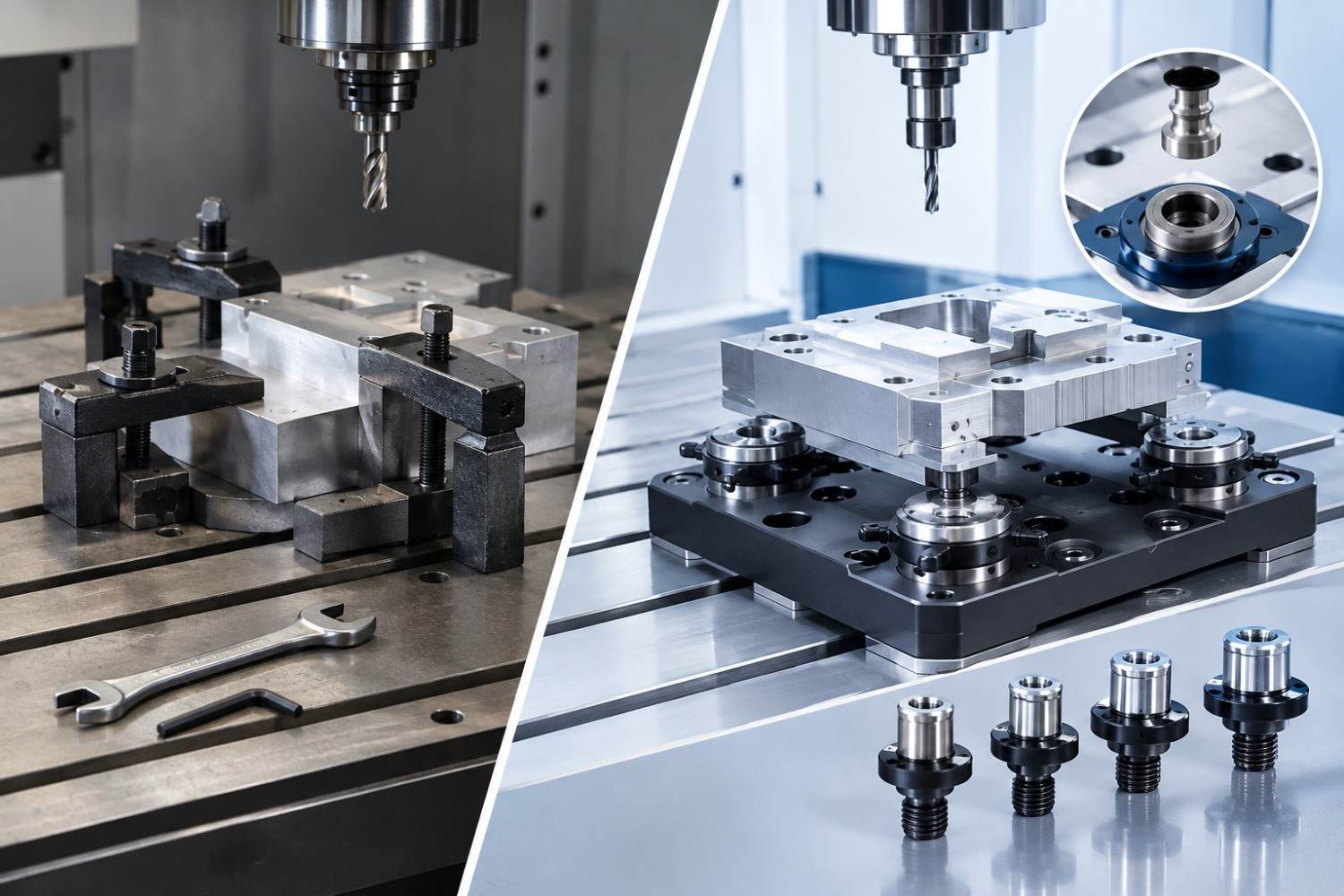
Every fixture, vice, and pallet in your shop is standardised to a common mounting interface, the zero-point receiver plate. This plate is mounted permanently on your machine table. Every fixture has a matching clamping module fitted to its base, with precision-machined pull studs.
When the fixture is placed on the receiver, the pull studs engage into pneumatically or manually operated chucks and the connection locks instantly. The result: repeatable positioning within 2 to 5 microns of the identical X, Y, and Z reference, every single time, with no operator measurement involved whatsoever.
Setup method comparison
| Setup method | Typical repeatability | Setup time |
|---|---|---|
| Manual indicating in vice | ±0.02 to ±0.10 mm | 20–60 minutes |
| Touch probe on machine | ±0.005 to ±0.020 mm | 5–15 minutes |
| Zero-point clamping | ±0.002 to ±0.005 mm | Under 60 seconds |
The Real Cost of Setup Time
Before zero-point clamping makes financial sense, you need to quantify what your setup time is actually costing. Most shops do not track this number which is precisely why setup time stays high year after year.
A CNC machining centre in India running at a fully-loaded cost of ₹1,500 to ₹3,000 per hour (depending on machine size, financing, and overhead allocation) loses that amount for every non-cutting hour. A machine running three job changes per day, each requiring 30 minutes of setup, wastes 1.5 hours of spindle time daily on pure non-value activity.
That number is what zero-point clamping is competing against. And it excludes the indirect costs: the skilled setter whose time is consumed by measurement rather than productive work, and the occasional scrap first-off that results from a datum setting error.
What a 30-Second Changeover Actually Means in Practice
The headline figure, 30-second fixture changeover is real for mature setups. But the more useful frame is this: what was a 30-minute job change becomes a 2-minute job change. You still need to load the pallet, confirm the programme, and start the cycle. What disappears entirely is the measurement work.
For a shop running three job changes per day, this converts 90 minutes of daily setup time into roughly 6 minutes. On a machine running 260 days per year, that recovers approximately 350 hours of spindle time, the equivalent of 8 to 9 additional working weeks of cutting capacity, without buying a new machine.
When Zero-Point Clamping Makes the Most Sense
High-mix, low-volume production
If your machine runs the same job for days at a stretch, zero-point clamping is beneficial but the payback is slower. If you change jobs three or more times per day, true of most precision engineering shops and machining contractors serving multiple OEM customers then the economics become compelling within 12 to 18 months. High-mix production is the environment this technology was designed for.
5-axis and multi-axis machining centres
On a 5-axis machine, positioning accuracy is not just about efficiency, it is about part quality. A 0.05 mm datum error in X or Y translates into angular errors when the rotary axis tilts, meaning features machined from different approach angles will not relate correctly to each other. Zero-point systems remove the human element from datum setting on your most accuracy-critical machines.
Lights-out and unmanned overnight production
Once fixtures are standardised to a zero-point receiver, pallet changeovers can be automated. For shops facing skilled labour constraints which in 2026 is most Indian precision engineering operations, the ability to queue pallets before the last operator leaves and run unattended overnight is a genuine competitive capability, not a theoretical aspiration.
Aerospace, automotive Tier 1, and medical component supply
These sectors demand documented positional accuracy and process repeatability. Zero-point clamping provides a systematic, auditable, and measurable approach to fixture positioning exactly what quality system auditors look for when evaluating your machining process.
Zero-Point Systems Available in India Through Jaypee Associates
Jaypee Associates is the authorised supplier of two zero-point clamping systems in India, covering the full range of machine configurations and investment levels.
Gerardi (Italy) — Pneumatic Zero-Point Kits
Gerardi S.p.A. produces the ART-81P pneumatic zero-point kit for vertical machining centres and the ART-82P for 5-axis machines. These systems integrate directly into your machine’s existing compressed air supply, no separate hydraulic pump required. Sub-5-micron repeatability with automatic clamping pressure verification before every cycle start.
Gerardi zero-point receivers are fully compatible with the Gerardi modular vise and vise tower range, enabling a complete zero-point workholding system built around a single interface standard.
Raptor — Manual and Pneumatic Systems
Raptor zero-point systems are available in both manual (no air supply required) and pneumatic configurations, making them practical for shops where routing pneumatic lines to a fixture is not feasible. Compatible with VMC, HMC, and 5-axis machines. Sub-5-micron repeatability, sub-30-second changeover.
Both systems include full application guidance from Jaypee Associates: receiver plate sizing for your machine table, pull stud selection, and fixture integration recommendations for your specific component range.
Calculating the Payback for Your Shop
The payback calculation is straightforward. You need three numbers:
- Job changes per day — how many times does the machine change from one job to another?
- Average current setup time — from last part of the previous job to first good part of the new job
- Machine hourly cost — fully loaded: depreciation, power, operator cost, and overhead
Multiply: (job changes per day) × (setup time in hours) × (machine hourly cost) × (working days per year). That is your annual setup cost. Compare it directly to the cost of the zero-point system.
Most shops running three or more setups per day find payback within 12 months. The system then operates for the life of the machine with no consumable cost beyond keeping receiver ports clean.
There is also a capability argument that does not appear in the calculation. A zero-point system makes your shop faster to respond to urgent orders a job can be set up in 2 minutes instead of 30 which changes what rush jobs you can realistically accept. It also reduces your dependency on your most experienced setters, and is a genuine differentiator when quoting to customers who run supplier process audits.
Frequently Asked Questions
Can zero-point clamping work with our existing fixtures?
Yes. Existing fixtures can be retrofitted with pull studs to make them zero-point compatible. The receiver plate is the only permanent machine modification required. Jaypee Associates can advise on retrofit feasibility for your specific fixture inventory.
What machine table sizes do the receivers accommodate?
Gerardi and Raptor receivers are sized to suit machine tables from small VMCs through large HMCs. They are machine-agnostic, the receiver bolts to the table and is not dependent on spindle interface standard.
Do pneumatic systems require air connections on every fixture?
On pneumatic systems, the receiver plate requires a pneumatic connection, typically a simple bayonet fitting. The fixture itself has no pneumatic requirement; the pull studs are purely mechanical. Raptor manual systems require no pneumatics at all.
What is the minimum configuration for an evaluation?
A typical starter system consists of one receiver plate and pull studs for two to four fixtures. Jaypee Associates can specify the correct configuration for your machine table and provide a detailed quote with payback calculation.
Speak to a Zero-Point Clamping Specialist
Jaypee Associates is the authorised supplier of Gerardi and Raptor zero-point systems in India. We will work through the payback calculation for your machine and recommend the correct configuration.
Table Of Contents
Recent Posts
5-Axis CNC Machining: How Advanced Tooling and Workholding Improve Precision?
30 Sep 2026

CNC Workholding Systems Market in 2026: Size, Trends & Future Growth
29 Sep 2026

Lights-Out CNC Machining: How Automated Workholding Enables Unattended Production?
28 Sep 2026
5 Reasons Your Fixture Is Not Delivering Consistent Results
17 Sep 2026