Best Clamping Systems for Aerospace Precision Parts
- Home
- /
- Best Clamping Systems for Aerospace Precision Parts
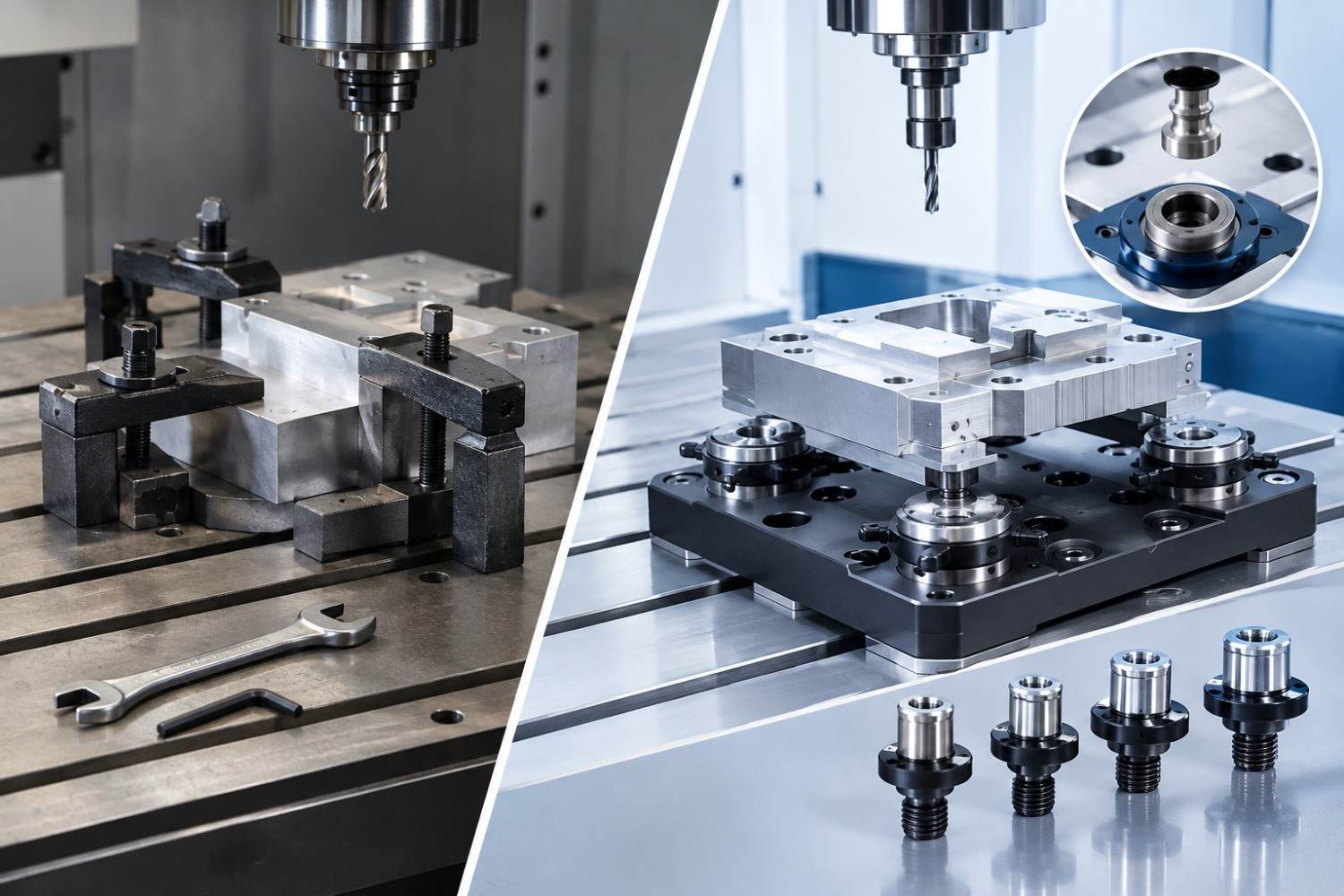
Aerospace machining is not very easy. It demands a lot of stability, accuracy and repeatability. When it comes to heavy-duty cutting of components made out of materials like Inconel and titanium, high rigidity is necessary. On the other hand, controlled clamping pressure is necessary to prevent deformation of thin-walled structural components. When it comes to choosing the right clamping systems for aerospace precision parts, these are some of the best options to choose from.
Zero-Point Clamping Systems
In some aerospace machining environments, there is a need for frequent change of components and multiple setups. Zero-point clamping systems are among the best options for these cases. These systems are known for their micron-level repeatability. These also allow rapid changes of pallets or workpieces.
Reduced setup and machine down time at the main advantages of these systems. It is possible to prepare the components off-site before they are transferred on to the machining centre. This helps manufacturers to maintain consistent positioning between operations. It makes zero-point systems especially useful for complex 5-axis aerospace components that need repeatable locating.
Hydraulic Power Vises and Clamps
It is essential to have strong, stable workholding while machining hard aerospace alloys. With the help of hydraulic power vises and clamps, it is possible to get significant clamping forces, generally in the range of about 10 to 100 kN, based on the application and system. Such types of systems are especially useful for heavy-duty roughing of:
- Forged structural brackets,
- Titanium components, and
- Other components that are exposed to substantial cutting forces
Throughout machining, stable pressure can be maintained with hydraulic actuation. It can reduce the risks of workpiece movement.
However, some components can get deformed due to excessive clamping force. Naturally, it is essential to control the amount of pressure according to the material, thickness of wall and workpiece geometry.
Modular and Specialized Collet Chucks
Hainbuch Spanntop systems and other modular collet chucks are perfect choices for rotational, cylindrical and ring-shaped aerospace components. Due to their concentric, wrap-around gripping method, there is more uniform distribution of pressure around the workpiece.
As compared to regular point-contact clamping, this approach can help to minimise distortion. Due to modular designs, it is also possible to change configurations as per machining requirements and variation in component sizes.
For engine rings and components that are similarly demanding, it is critical to maintain concentricity. It can be easy to improve both machining consistency and workholding stability with the aid of a specialised collet chuck.
Vacuum and Low-Force Fixtures
It is not necessary to use high clamping forces for every aerospace component. When subjected to conventional mechanical jaws, delicate non-ferrous structures, composite panels and thin-skinned sheet metal can get warped.
Vacuum and low-force fixtures offer a useful alternative. These can support the component across a wider area as well as reduce concentrated pressure as much as possible. It can be useful in maintaining the original geometry of the workpiece, both at the time of machining and during finishing operations.
Such types of fixtures are especially useful when surface quality and dimensional accuracy are more critical than resisting very high cutting loads.
Adjustable Matrix and Pin Clamps
Aerospace components often feature complex free-form surfaces. It can be challenging to secure them with the help of standard fixtures. Adjustable matrix and pin clamping systems, including the FCS System and other solutions available in the market, can conform to irregular aerodynamic geometries.
Individual support points can be positioned in a proper way, to match the component. It can help to distribute support across complicated surfaces. It can also reduce motion and machining vibrations, especially during multi-axis cutting.
Workholding errors cannot be tolerated in aerospace precision machining. It is necessary to choose the right clamping system that can offer enough stability to withstand cutting forces with no compromise on the dimensional integrity of the component.
Frequently Asked Questions
What makes zero-point clamping systems suitable for aerospace machining?
Zero-point clamping systems are suitable for aerospace machining when frequent component changes and multiple setups are required. They support rapid pallet or workpiece changes, micron-level repeatability and reduced setup downtime.
When should hydraulic power vises and clamps be used?
Hydraulic power vises and clamps should be used for heavy-duty machining of hard aerospace alloys, including forged structural brackets and titanium components. Working with a manufacturer or distributor that acts as a dedicated partner rather than simply a hardware supplier can also help support demanding machining requirements.
How do modular collet chucks help prevent workpiece distortion?
Modular collet chucks help distribute pressure more uniformly around cylindrical or ring-shaped components while maintaining concentricity during machining. This can minimize workpiece distortion and support consistent machining results.
When are vacuum and low-force fixtures preferred?
Vacuum and low-force fixtures are preferred for thin-skinned sheet metal, composite panels and non-ferrous structures. They provide wider-area support and reduce concentrated pressure that could warp or distort the workpiece.
Why are adjustable matrix and pin clamps useful for complex aerospace parts?
Adjustable matrix and pin clamps can conform to complex free-form and aerodynamic surfaces. Their individual support points can help reduce movement, distribute support more effectively and minimize machining vibrations during multi-axis cutting.
Table Of Contents
Recent Posts
5-Axis CNC Machining: How Advanced Tooling and Workholding Improve Precision?
30 Sep 2026
CNC Workholding Systems Market in 2026: Size, Trends & Future Growth
29 Sep 2026
Lights-Out CNC Machining: How Automated Workholding Enables Unattended Production?
28 Sep 2026
5 Reasons Your Fixture Is Not Delivering Consistent Results
17 Sep 2026