CNC Workholding Systems Market in 2026: Size, Trends & Future Growth
- Home
- /
- CNC Workholding Systems Market in 2026: Size, Trends & Future Growth
In 2026, the global CNC workholding systems market is worth over a billion. And the market is expanding very fast. Today, in machining operations, workholding systems are turning out to be more and more essential. This is natural, given that manufacturers need more precision, flexibility and productivity.
There is a lot of variation in value in the broader workholding and devices segment. It depends on whether related tooling is included. Take a look at the CNC workholding systems market in 2026, including its size, trends and future growth scope.
Size of Market
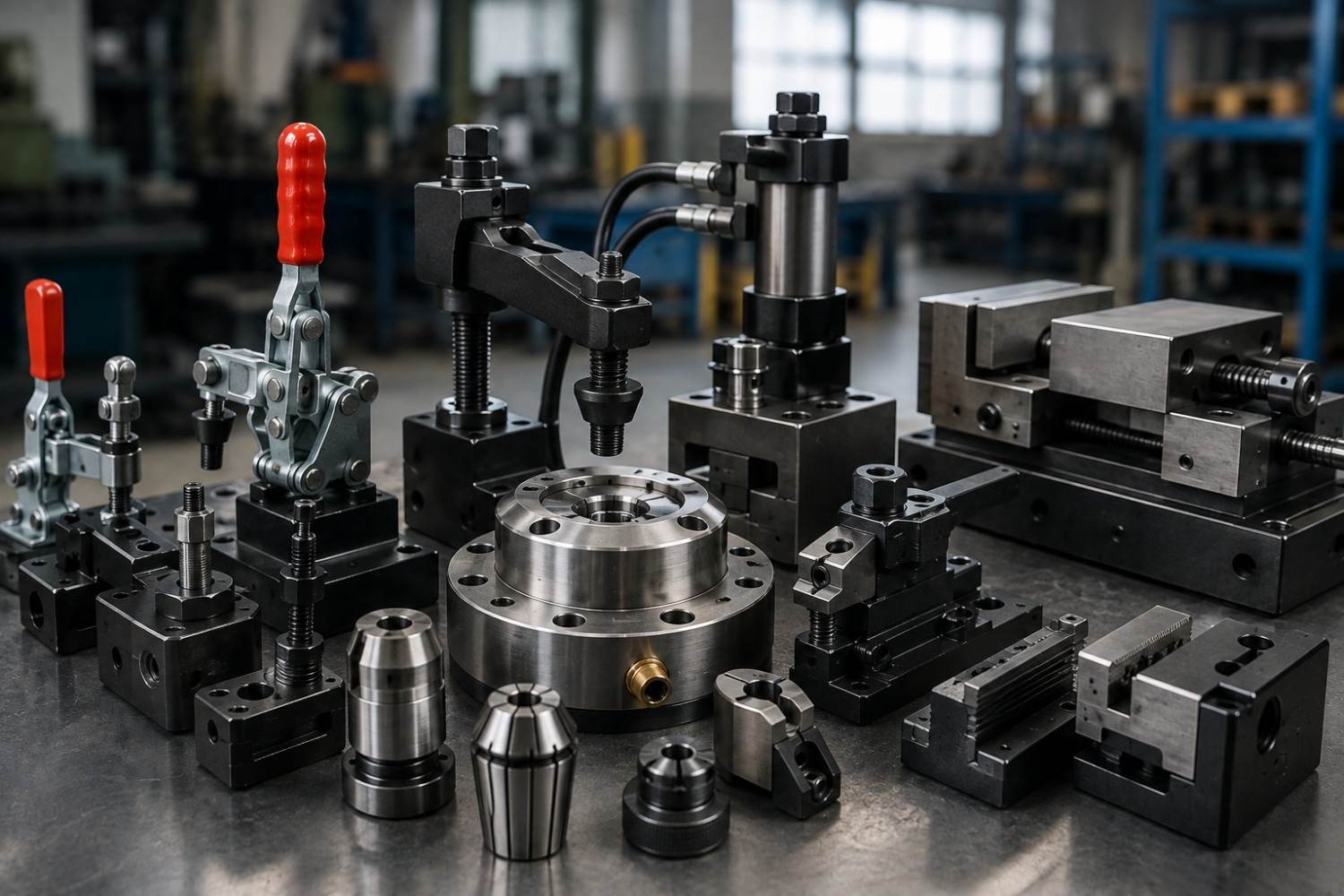
Different types of workholding systems constitute the market. Vises are still a top product category. These bring in a sizeable system-type revenue (23%). This shows that these are still essential across CNC machining applications.
Presently, manual actuation is also experiencing a lot of demand (31%). But pneumatic and automated hydraulic workholding solutions are still complementing this traditional segment. These are getting more attention of manufacturers who are trying to improve consistency and reduce manual intervention.
Around one-third of the market is represented by milling applications and machining centres. Additive manufacturing post-processing, at the same time, is turning out to be a particularly fast-growing application (around 11.2% projected CAGR).
Top Trends
Various trends are now becoming noticeable in the market, including:
Higher demand for flexibility
There is more focus on high-mix, low-volume production, which is one of the most defining trends this year. Manufacturers have to increasingly handle various components without wasting a lot of time in the setup process. They can address this problem with zero-point clamping configurations and quick-change jaw systems. These help them to change workpieces and fixtures in just a few seconds.
Such kind of flexibility can be especially useful for manufacturers who are involved with the production of customized components, smaller batches and frequently changing product variants.
Need for better clamping precision
With better quality expectations and rising material expenses, manufacturers are trying to improve clamping accuracy today. When uneven or excessive force is applied, delicate and thin-walled components can get deformed easily.
It is possible to get more controlled clamping forces with advanced pneumatic and hydraulic systems. Manufacturers can handle sensitive components with more consistency. Due to better control, it is also easier to reduce scrap resulting from workholding-related deformation.
Growing need for automation
In 2026, the market is also being shaped by automation. Validated and interchangeable workholding configurations compatible with robotic loading systems are increasingly being required for automated CNC cells and 5-axis machines.
At a time when more connected production environments are being adopted in factories worldwide, workholding solutions have to support rapid changeovers and repeatable positioning. Manufacturers are, naturally, looking for systems that are specifically designed for automated manufacturing workflows.
Future Growth Scope
Regional manufacturing expansion will continue to drive growth. Asia-Pacific continues to anchor global CNC tool demand. It accounts for over half of broader CNC tool market revenue (55%). In countries like India and China, localised supply chains and manufacturing investments are expanding rapidly.
On the other hand, in Europe and North America, reshoring initiatives are increasing manufacturers to replace older fixtures and modernize production equipment. This transition is getting more interesting with AI-driven digital monitoring. It is supporting the adoption of smart, high-repeatability workholding systems.
It is now evident that precision, automation, flexibility and digital manufacturing will be the future of the CNC workholding market. Manual systems and traditional vises continue to be important. However, quick-change configurations, automated clamping and smart workholding are being adopted more and more. With manufacturers trying to reduce setup period and scrap as well as making the production process more adaptable, it is easy to understand that workholding systems will play an increasingly strategic part of the CNC manufacturing ecosystem.
Frequently Asked Questions
What is driving the CNC workholding systems market in 2026?
The CNC workholding systems market is being driven by growing demand for greater flexibility, precision, automation and productivity in modern machining operations.
Which CNC workholding system is a major product category?
Vises are a major CNC workholding system category, accounting for approximately 23% of system-type revenue.
Why are quick-change workholding systems becoming popular?
Quick-change workholding systems enable faster setup and changeovers, making them particularly useful for low-volume, high-mix production where flexibility and reduced downtime are important.
Table Of Contents
Recent Posts
5-Axis CNC Machining: How Advanced Tooling and Workholding Improve Precision?
30 Sep 2026
Lights-Out CNC Machining: How Automated Workholding Enables Unattended Production?
28 Sep 2026
5 Reasons Your Fixture Is Not Delivering Consistent Results
17 Sep 2026
Zero-Point Clamping vs Traditional Clamping Systems
15 Sep 2026